
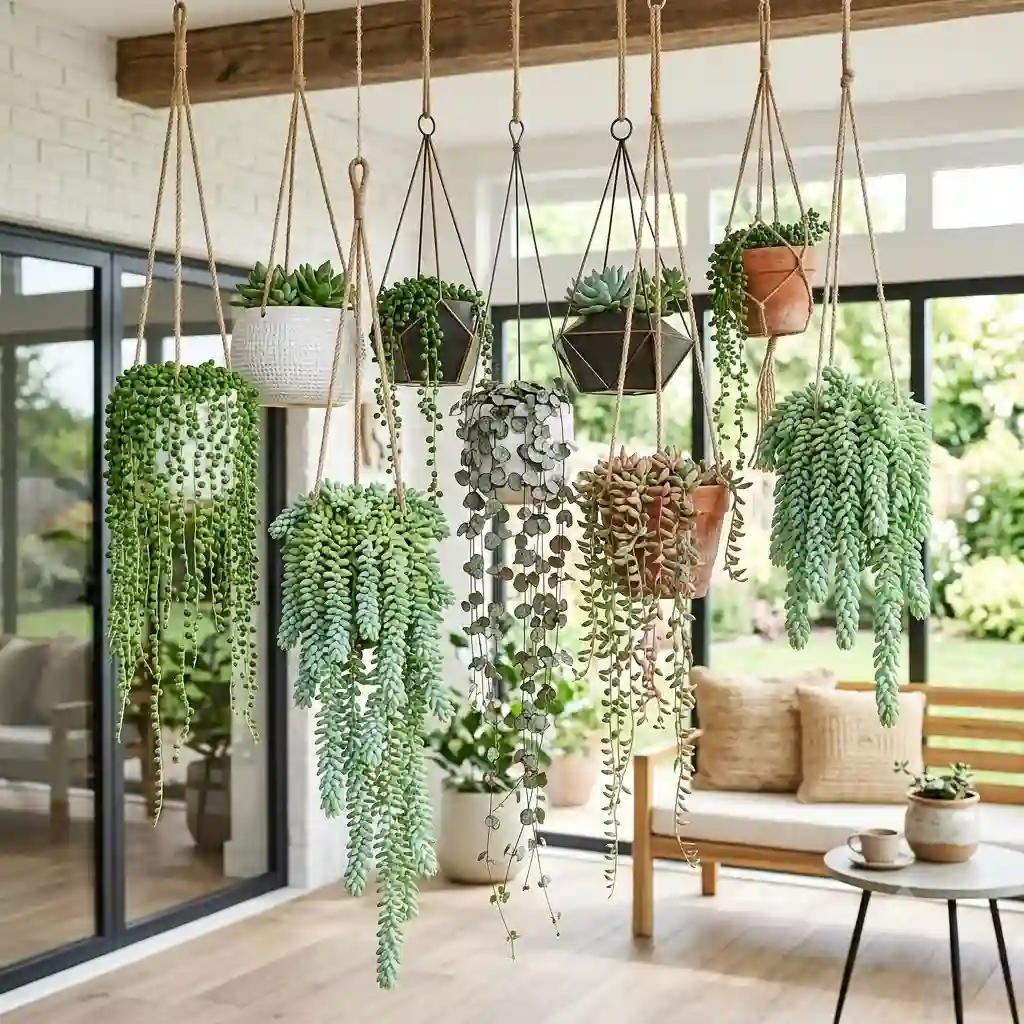
What is the perfect cascading plant for your space? In my 10+ years of working as an indoor landscape consultant and botanical designer, I’ve found that trailing drought-tolerant plants offer a unique architectural element that standard upright plants simply cannot match. If you are looking for succulents for hanging pots, you are stepping into a fascinating world of botany where gravity and phototropism interact to create stunning living curtains.
Many beginners assume that throwing any drought-tolerant plant into a suspended basket will work out fine. “It’s a succulent, it’s unkillable,” they think. In reality, suspended microclimates are vastly different from windowsill environments. The air circulation is higher, the ambient humidity is lower, and the light exposure shifts dramatically depending on your ceiling height and window placement. You need plants that are biologically adapted to trail, equipped with specific leaf structures—like epidermal windows (fenestrations) or thick cuticles—that manage water retention while cascading downward.
In this comprehensive guide, I am not just going to list pretty plants. We are going to dive into the exact growth habits, root system requirements, and hidden maintenance quirks of the top trailing varieties on the market. Whether you are a busy professional looking for low-maintenance greenery or a collector seeking a rare conversation piece, my field tests and first-hand experience will help you navigate past the marketing hype to find a plant that will actually thrive in your home.
Quick Comparison: Top Trailing Succulents at a Glance
| Plant Name | Growth Rate | Light Requirement | Watering Frequency | Best For |
| String of Pearls | Moderate | Bright, indirect | Every 10-14 days | Visually striking window displays |
| Burro’s Tail | Slow | Bright, direct | Every 14-21 days | High-light, low-traffic areas |
| String of Hearts | Fast | Medium to bright | Every 7-10 days | Beginners and lower-light spots |
| String of Dolphins | Moderate | Bright, indirect | Every 10-14 days | Novelty collectors |
| String of Bananas | Fast | Bright, indirect | Every 10-14 days | Rapid vertical coverage |
Looking at the comparison above, the String of Hearts clearly delivers the best value for beginners due to its rapid growth rate and tolerance for slightly lower light conditions. However, if your room gets blasted by intense afternoon sun, the thick turgor pressure in the leaves of a Burro’s Tail justifies its slower growth rate, as it won’t scorch as easily. Budget buyers and impatient decorators should note that while the String of Pearls is iconic, it requires much stricter moisture management than the highly resilient String of Bananas.
💬 Just one click — help others make better buying decisions too! 😊
[addtoany]
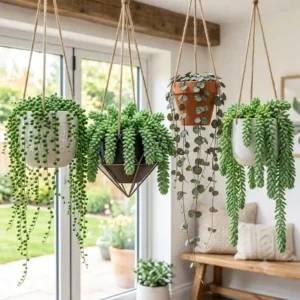
Top 5 Trailing Succulent Live Plants: Expert Analysis
1. Costa Farms String of Pearls Live Indoor Plant
The Costa Farms String of Pearls is an iconic trailing beauty characterized by its perfectly spherical, pea-like leaves that cascade elegantly over the edges of suspended planters.
Shipped in a standard 6-inch grower pot, this plant features fully rooted, established vines ranging from 8 to 12 inches right out of the box. What the spec sheet won’t tell you is the importance of those established roots; unlike cheap cuttings that rot within a week, these mature root systems allow the plant to properly utilize capillary action to draw up moisture from the bottom of the pot. In my experience, this robust root network is the difference between a thriving living curtain and a shriveled, frustrating mess.
This specific offering is best for intermediate plant parents who want an immediate visual impact and have a brightly lit, east-facing window. I’ve seen too many beginners hang these in dark corners where the spherical leaves lose their plumpness due to insufficient photosynthesis. Customers consistently praise the secure packaging, though some note the soil arrives quite damp, requiring a brief drying-out period before hanging.
Pros:
-
Arrives with impressively long, established vines
-
Spherical leaves feature prominent “epidermal windows” for efficient light absorption
-
Packaging effectively prevents transit damage
Cons:
-
Grower soil retains slightly too much moisture for long-term suspended use
-
Top-heavy vines can easily snap if handled roughly during unboxing
Price Verdict: Retailing in the $25-$35 range, this established plant offers excellent immediate ROI compared to buying fragile, microscopic starter plugs that take years to trail.
2. Shop Succulents Burro’s Tail (Sedum morganianum)
The Shop Succulents Burro’s Tail offers thick, braided-looking stems packed tightly with teardrop-shaped, pale green leaves that can eventually reach up to three feet in length.
This plant is shipped fully rooted in a 6-inch pot, pre-acclimated to standard indoor humidity levels. The critical specification here is the heavy wax coating (epicuticular wax) on the leaves, which makes this plant incredibly drought-resistant. Practically, this means you can forget to water it for three weeks while on vacation, and it won’t drop a single leaf. However, the stems become remarkably heavy as they grow, meaning your suspension hardware must be anchored into a ceiling stud, not just drywall.
I highly recommend this for high-light, low-traffic areas like a sunny stairwell or an inaccessible skylight. What most buyers overlook is the fragility of the turgid leaves; brushing past them will knock them off. My neighbor’s golden retriever wagged its tail near one, and we spent twenty minutes sweeping up the foliage. Reviewers love the sheer density of the plant upon arrival but frequently warn about the leaves dropping during the initial unboxing process.
Pros:
-
Incredibly drought-tolerant, ideal for forgetful waterers
-
Dense, heavy foliage creates a substantial, sculptural look
-
Dropped leaves can be easily propagated into new plants
Cons:
-
Extreme mechanical fragility; leaves detach at the slightest touch
-
Requires heavy-duty ceiling anchors as it matures
Price Verdict: Typically found in the mid-$20s, it is a phenomenal long-term investment, though you must factor in the hidden cost of purchasing high-quality suspension hardware.
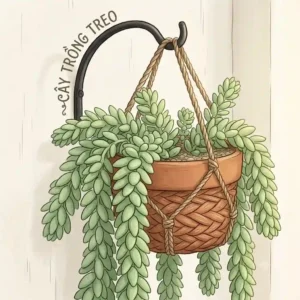
3. Altman Plants String of Hearts (Ceropegia woodii)
The Altman Plants String of Hearts isn’t a true succulent but a semi-succulent vine, known for its delicate, wire-like stems and heart-shaped, mottled silver-and-green leaves.
This plant arrives in a smaller 4-inch nursery pot, boasting incredible vining speed. The real-world meaning of its semi-succulent nature is that it possesses specialized underground tubers (caudexes) that store water. This unique biology allows the plant to tolerate the dry soil conditions of a suspended pot without requiring the intense, direct sunlight that true desert plants demand. You can actually hang this slightly further away from the window than a String of Pearls.
This is my absolute top recommendation for beginners. If you’ve killed trailing plants before, the String of Hearts is your redemption arc. The vines are incredibly tough and won’t snap if you accidentally pull on them while dusting. Most reviewers claim it grows inches per week during the summer, but in practice, I found that this explosive growth only happens if you fertilize it lightly every month.
Pros:
-
Extremely fast growth rate provides quick vertical coverage
-
Tolerates medium-light environments better than most trailing varieties
-
Wire-like stems are surprisingly durable and resist snapping
Cons:
-
Vines can become easily tangled, requiring gentle, regular detangling
-
Requires slightly more frequent watering than true desert varieties
Price Verdict: Priced nicely under $20, it offers the fastest transformation for your space, delivering exceptional value for impatient interior decorators.
4. Succulent Box String of Dolphins
The Succulent Box String of Dolphins is a rare, hybrid novelty plant (a cross between String of Pearls and Candle Plant) featuring leaves that perfectly mimic a pod of leaping dolphins.
Shipped as a 2-inch starter plug, this is a much smaller offering designed for careful cultivation. The key biological feature here is its high surface-area-to-volume ratio in the leaves compared to a String of Pearls. This means it respires faster and actually prefers slightly cooler indoor temperatures and a bit more frequent watering. If you let it dry out to the point of bone-dry dust, the “dolphins” will lose their shape and look more like shriveled stingrays.
I suggest this exclusively for novelty collectors and desktop hangers. Because it arrives so small, you shouldn’t expect it to serve as a massive window curtain for at least 18 months. The spec sheet won’t tell you this, but I’ve found it thrives best when planted in a shallow, wide terracotta bowl suspended by macrame, allowing the roots to spread laterally. Customers rave about the unique leaf shape but occasionally express surprise at the petite size of the initial plug.
Pros:
-
Unbeatable, unique aesthetic that serves as a major conversation starter
-
Excellent for smaller spaces, terrariums, or desktop hangers
-
Readily branches out if the trailing stems are occasionally pruned
Cons:
-
Arrives very small; requires patience to achieve a trailing effect
-
“Dolphin” shape can distort if the plant receives inadequate light
Price Verdict: Usually sitting in the $15-$20 range, you are paying a premium for the rare genetics rather than the volume of foliage, making it a high-value purchase for collectors.
5. California Tropics String of Bananas
The California Tropics String of Bananas (Senecio radicans) is the rugged, muscular cousin of the String of Pearls, featuring thick, curved, banana-shaped foliage.
Arriving in a 4-inch hanging basket, this plant boasts incredibly robust, fast-growing vines. The practical interpretation of its thicker, more elongated leaf structure is that it possesses stronger cellular walls. This makes it dramatically more resilient to common indoor care mistakes. It handles accidental overwatering better than other trailing varieties, and its stems won’t snap easily if you need to move the pot to clean your windows.
If you are a busy professional or a college student looking for an indestructible living curtain, this is your perfect match. What most buyers overlook about this model is how vigorously it responds to pruning. Snip the ends, and it branches aggressively, creating a bushy, thick canopy at the soil line. Customer feedback heavily highlights its aggressive growth and forgiving nature, with many stating it survived severe neglect.
Pros:
-
Highly forgiving of erratic watering schedules and environmental shifts
-
Fast-growing, thick vines create a lush, full appearance quickly
-
Extremely easy to propagate from simple stem cuttings
Cons:
-
Lacks the delicate, dainty aesthetic of finer trailing vines
-
Can become wildly overgrown and heavy, requiring regular pruning
Price Verdict: Floating around $20, it is arguably the most cost-effective option on the market when calculating the volume of growth you get per dollar spent.
✨ Don’t Miss These Exclusive Deals!
🔍 Take your vertical garden to the next level with these carefully selected live plants. Click on any highlighted item to check current pricing and availability. These plants will help you create authentic, cascading greenery your family will love!
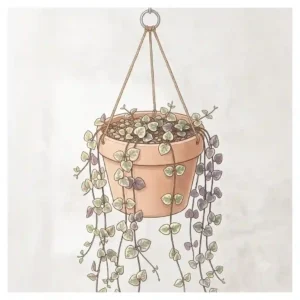
Practical Usage Guide: Setting Up Your Aerial Oasis
Hanging a plant isn’t as simple as driving a nail into the wall and walking away. To ensure your succulents for hanging pots thrive long-term, you must optimize their microclimate and structural setup.
Step 1: The Soil-to-Air Swap
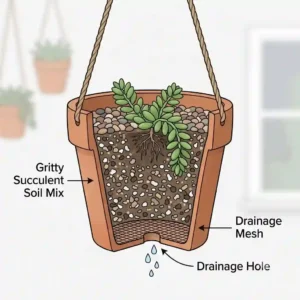
Most commercially shipped plants arrive in heavy peat moss. While great for nursery growth, peat retains too much water for a suspended indoor environment. Within your first 30 days, I highly recommend repotting. Create a mix of 50% premium potting soil, 25% coarse perlite, and 25% horticultural pumice. This mimics the rapid drainage of their natural arid habitats and prevents root rot (Phytophthora).
Step 2: Mastering the Suspension
Never hang a heavy, saturated pot from drywall using a standard hook. Always use a stud finder to anchor into the ceiling joists, or use heavy-duty toggle bolts rated for at least 30 lbs. Remember, a freshly watered 6-inch ceramic pot can weigh upwards of 10 pounds. I prefer using adjustable macrame hangers, which allow you to lower the plant easily for watering without needing a stepladder.
Step 3: The Watering Ritual
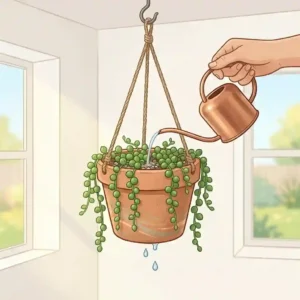
Watering suspended plants usually ruins floors. The insider trick? Don’t water them where they hang. Unhook the pot, bring it to the sink, and flush it with room-temperature water until it pours out the drainage holes. Let it sit for 20 minutes to drain completely before re-hanging. This ensures deep root saturation while keeping your hardwood floors completely dry.
Problem-Solving Clinic: Rescuing Dying Hanging Succulents
Even perfect products can fail if mismanaged. Here are the most common problems I see in the field with cascading greenery, and exactly how to fix them.
Problem 1: Shriveled, Raisin-like Leaves
The Cause: Surprisingly, this can be from under-watering or severe over-watering. If you overwater, the roots rot and can no longer uptake moisture, causing the leaves to shrivel.
The Solution: Check the soil deep in the pot. If it’s bone dry, soak it. If it’s soggy, you must immediately remove the plant, trim the black, mushy roots, and repot it in fresh, dry pumice-heavy soil.
Problem 2: Balding at the Crown
The Cause: The top of the pot is completely bare, but the trailing vines look okay. This happens because the rim of the pot or the window frame is blocking sunlight from hitting the top of the soil.
The Solution: You need to lower the plant so the top of the pot receives direct light. To fix the baldness, take cuttings from the bottom of the vines and lay them directly on top of the soil. They will root and fill in the crown.
Problem 3: Stretched, Leggy Vines (Etiolation)
The Cause: The space between the leaves is growing wider, and the plant looks stringy. This is a desperate phototropic response—the plant is stretching to find more light.
The Solution: Move the plant closer to a south or west-facing window. You cannot reverse etiolation, so your best move is to prune the leggy growth and let the plant regrow densely in the new, brighter location.
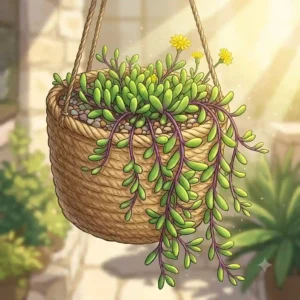
Buyer’s Decision Framework: Matching Plant to Lifestyle
If you are overwhelmed by choices, use this simple framework to match your lifestyle to the ideal botanical companion.
If you are a frequent traveler (Gone 2+ weeks at a time)…
Choose: The Shop Succulents Burro’s Tail.
Reason: Its heavy epicuticular wax and massive water-storing leaves mean it practically thrives on neglect. You can leave it for a month, and it won’t even flinch.
If you have a modern, minimalist apartment with medium light…
Choose: The Altman Plants String of Hearts.
Reason: It tolerates lower light levels better than desert natives, and its delicate, wire-like structure complements clean, architectural lines perfectly without looking overgrown.
If you want a massive, jungle-like aesthetic as fast as possible…
Choose: The California Tropics String of Bananas.
Reason: It has the most aggressive growth rate. Feed it a diluted liquid fertilizer during the summer, and it will give you feet of cascading foliage in a single season.
If you are a meticulous caretaker who loves styling and details…
Choose: The Costa Farms String of Pearls.
Reason: It requires careful attention to watering and light balance, but rewards you with the most iconic, magazine-worthy aesthetic of any trailing plant.
How to Choose the Perfect Trailing Succulent
Selecting the right plant goes far beyond picking the prettiest foliage. In my consulting work, I evaluate plants based on a strict set of biological and environmental criteria.
-
Assess Your True Light Profile: Human eyes automatically adjust to dark rooms, making us terrible judges of light. Download a light meter app on your phone. If your hanging spot gets less than 200 foot-candles of light, do not buy a String of Pearls. You will need a shade-tolerant option, or you must invest in a suspended grow light.
-
Evaluate the Container Weight: Terracotta breathes beautifully, wicking away excess moisture, but it is incredibly heavy. Plastic grower pots are lightweight, putting less strain on your ceiling hardware, but they trap moisture. If you use plastic, you must compensate with a highly porous soil mix.
-
Analyze Root Structure: When inspecting a new arrival, gently tug the base of the stems. You want a plant that feels anchored. If the plant lifts out of the soil easily, it’s a fresh cutting, not an established plant. Fresh cuttings need high humidity to root, which is incredibly difficult to maintain in a hanging basket.
-
Consider Ambient Airflow: Hanging plants are constantly exposed to HVAC vents, ceiling fans, and open windows. Plants with thicker cuticles (like the Burro’s Tail) resist this dehydrating airflow effortlessly, while thinner-leaved varieties might crisp up at the edges.
Common Mistakes When Buying Live Plants Online
The convenience of online plant shopping is incredible, but there are hidden pitfalls that the beautiful nursery photos won’t reveal.
The most common mistake I see is ignoring seasonal shipping temperatures. Succulents are essentially bags of water. If you order a live plant in January and you live in Minnesota, sitting on a freezing porch for two hours will cause the plant cells to burst, turning the plant to black mush. Always ensure the seller includes a “heat pack” during winter months, or wait until spring to order.
Another massive pitfall is the immediate repotting urge. When a plant arrives in a dark, bouncing cardboard box after three days in transit, it is in physiological shock. Pulling it out of the box, tearing away its soil, and stuffing it into a new decorative pot is a recipe for root shock and sudden leaf drop. The insider trick? Leave the plant in its ugly plastic nursery pot for at least 14 days. Let it acclimate to your home’s unique temperature and humidity before subjecting it to the trauma of repotting.
Lastly, buyers often mistake transit damage for disease. It is completely normal for a trailing plant to lose 5% of its leaves during shipping. Don’t immediately blast it with harsh chemical fungicides. Clean up the loose debris, give it gentle light, and observe it for a week.
Trailing Titans: String of Pearls vs. String of Hearts
When clients ask me for a delicate, vining aesthetic, the conversation always comes down to these two heavyweights. A simple table doesn’t do justice to how differently these plants operate in a home environment.
The String of Pearls (Senecio rowleyanus) is a true succulent from the dry regions of Southwest Africa. It requires bright, indirect light shining directly on the top of the pot to thrive. Its spherical leaves are an evolutionary marvel—designed to minimize surface area exposed to the hot sun while maximizing water storage. However, this exact evolutionary trait makes it highly susceptible to overwatering. The root system is shallow and fine. If the soil stays wet for more than a few days, those fine roots suffocate and rot.
On the other hand, the String of Hearts (Ceropegia woodii) hails from South Africa but grows naturally in the dappled shade of taller bushes. It is a semi-succulent vine that relies on underground tubers (caudexes) to store water, rather than storing it all in its leaves. This is a game-changer for indoor care. It means the plant can tolerate lower light levels—the “dappled shade” of a living room—and is much more forgiving of varying soil moisture.
If your hanging pot is positioned high up where the top soil won’t get direct sunlight, the String of Hearts will survive beautifully, while the String of Pearls will inevitably go bald at the crown.
What to Expect: Real-World Performance & Growth Timelines
The time-lapse videos you see on social media create a highly skewed expectation of plant growth. Let’s ground those expectations in reality.
Month 1: The Acclimation Phase
During the first 30 days, do not expect any new growth. The plant is adjusting its stomata (breathing pores) to your home’s specific humidity and rerouting energy to repair micro-damages to its root system from shipping. In fact, expect a bit of leaf drop. This is normal triage.
Months 2-6: The Vegetative Push
Assuming adequate light and proper watering, this is when you’ll see the magic happen. A String of Bananas or String of Hearts might push out 1 to 2 inches of new vine per week during the spring and summer. You will notice the new leaves are often a lighter, brighter green, slowly darkening as they mature.
Months 6-12: The Maturation and Maintenance Phase
As the vines reach a certain length (often 2 to 3 feet), the plant must expend significantly more energy to pump water via capillary action all the way to the tips. Growth will naturally slow down. At this one-year mark, the soil has likely become depleted of nutrients and compacted. You will need to begin a regimen of diluted liquid fertilizer (I recommend a half-strength 10-10-10 NPK ratio) to sustain the massive volume of foliage you’ve cultivated.
Long-Term Cost & Maintenance: Beyond the Purchase Price
A plant is not a static piece of furniture; it is a living organism with an ongoing Total Cost of Ownership (TCO). While the initial $20-$30 purchase price seems cheap, the hidden costs of proper maintenance add up.
The ‘Efficiency Gap’ in indoor gardening usually comes from cheap soil and poor lighting. If you rely on the generic nursery soil, the soil will eventually become hydrophobic (repelling water). You will spend 20 minutes trying to water a plant where the water simply runs down the sides of the pot. To prevent this, you must invest in premium, coarse amendments—a bag of high-grade horticultural pumice and specialized succulent fertilizer will cost you an additional $20-$30 annually.
Furthermore, there is the time investment. A dense, trailing plant requires “grooming.” Dead leaves must be meticulously removed to prevent fungal outbreaks (like Botrytis) from taking hold in the dense canopy. You will spend roughly 10 minutes per week inspecting, rotating, and grooming a mature hanging basket to keep it looking magazine-ready. The true cost of an aerial oasis is paid in consistent, attentive maintenance.
According to research from the National Gardening Association, proper soil aeration and light management are the two largest predictors of long-term indoor plant survival, emphasizing that the initial purchase is just the down payment on your botanical investment.
✨ Don’t Miss These Exclusive Deals!
🔍 Ensure your vertical garden thrives with the right tools! Click on any highlighted plant or accessory to check current pricing and availability. Getting the right gear on day one prevents months of frustration.
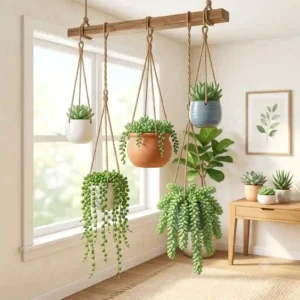
Conclusion: Elevating Your Indoor Jungle
Bringing cascading greenery into your home is one of the most rewarding interior design upgrades you can make. By choosing the right succulents for hanging pots—whether it’s the architectural durability of the Burro’s Tail, the rapid growth of the String of Hearts, or the iconic elegance of the String of Pearls—you transform dead airspace into a vibrant, living canopy.
Remember that success relies on understanding the ‘why’ behind the ‘what.’ Don’t just hang them and hope for the best; optimize their soil for rapid drainage, secure them safely to your ceilings, and respect their need for bright, nourishing light. If you follow the expert insights and maintenance cycles laid out in this guide, your suspended garden won’t just survive the season—it will thrive for years to come.
FAQs
❓ How often should I water succulents for hanging pots?
✅ Typically every 10 to 14 days, but it depends heavily on your environment. Allow the soil to dry completely out to the bottom of the pot. When you do water, soak it thoroughly until water drains freely from the bottom holes…
❓ Can trailing succulents survive in low light?
✅ Most true desert varieties will stretch and slowly die in low light. However, semi-succulents like the String of Hearts can adapt to medium-light environments, though their growth will slow significantly compared to bright, indirect light…
❓ Why are the beads on my String of Pearls turning brown and mushy?
✅ This is the classic sign of root rot caused by overwatering or poor drainage. The roots have suffocated, and the plant is literally bursting its water-storage cells. You must repot immediately into dry, coarse soil…
❓ Do hanging pots need drainage holes?
✅ Absolutely. It is biologically impossible to keep trailing desert plants healthy long-term in pots without drainage. If you love a decorative pot with no holes, use it as a “cachepot” and place a plastic nursery pot inside it…
❓ How do I make my trailing plant look fuller at the top?
✅ Prune the long, leggy vines and propagate the cuttings by pinning them directly into the topsoil. Ensure the crown of the plant is receiving adequate overhead light, otherwise, new growth will refuse to sprout…
Recommended for You
- 5 Best hanging basket plants to Transform Your Space in 2026
- 5 Best Planters for Perennial Hanging Baskets in 2026 (Expert Tested)
- 5 Ultimate nice hanging baskets for 2026 (Expert Tested)
Disclaimer: This article contains affiliate links. As an Amazon Associate, I earn from qualifying purchases. If you purchase products through these links, we may earn a small commission at no additional cost to you.
✨ Found this helpful? Share it with your friends! 💬🤗
[addtoany]
