
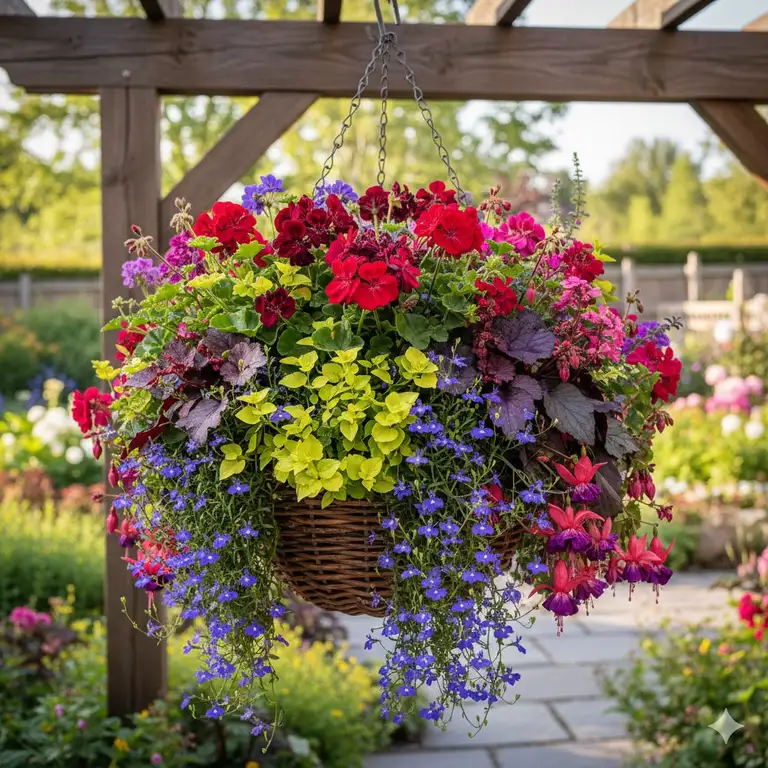
Let’s be real for a second: annuals are the “one-night stands” of the gardening world. They show up, look fabulous for a few months, demand constant attention, and then leave you heartbroken (and with an empty pot) as soon as the first frost hits. If you are tired of the endless cycle of buying, planting, and tossing plants every year, it is time to look at the best perennials for hanging baskets.
✨Was this helpful? Spread the word! 🚀
I remember the first time I realized I could put perennials in a basket. I was staring at a sad, wilted petunia in July and looked over at the Heuchera thriving in my shade garden. A lightbulb went off. Why wasn’t I using plants that actually want to live? By choosing the best perennials for hanging baskets, you aren’t just planting a garden; you’re making an investment. You get plants that return year after year, often with more vigor and beauty than the season before.
Why Switch to Perennials for Your Baskets?
Perennials offer a level of sophisticated texture and structural integrity that most annuals simply cannot match. While petunias are great for a splash of neon, perennials like Creeping Jenny or Hosta provide architectural interest. Furthermore, many of these plants are significantly more drought-tolerant once established. Consequently, you won’t find yourself chained to a watering can every time the temperature hits 85 degrees.
Before we dive into my top picks, let’s look at how these hardy heroes stack up against their short-lived cousins.
| Feature | Perennials in Baskets | Annuals in Baskets |
| Lifespan | 3–5+ years with care | One season (3–5 months) |
| Cost Efficiency | High (buy once, keep forever) | Low (must repurchase every year) |
| Root System | Deep and robust | Shallow and demanding |
| Maintenance | Low to Moderate | High (deadheading/daily watering) |
| Season Interest | Often year-round (evergreens) | Bloom-heavy then dies |
| Soil Needs | High-quality drainage required | Standard potting mix |
Quick Comparison: Top 7 Best Perennials for Hanging Baskets
If you’re in a hurry to get your hands dirty, here is a snapshot of the top contenders currently available for your US-based garden.
| Product Name | Best For | Light Level | Growth Habit |
| Proven Winners Heuchera | Color & Foliage | Part Shade to Shade | Mounding/Slightly Trailing |
| Sedum ‘Angelina’ | Drought Resistance | Full Sun | Trailing Groundcover |
| Lysimachia ‘Aurea’ | Dramatic “Spill” | Sun to Part Shade | Aggressive Trailer |
| English Ivy ‘Glacier’ | Classic Elegance | Shade to Part Sun | Long Vines |
| Vinca Minor ‘Bowles’ | Early Spring Blooms | Shade to Full Sun | Groundcover/Trailer |
| Phlox subulata | Floral Carpet | Full Sun | Mounding Trailer |
| Tassel Fern | Textural Contrast | Deep Shade | Upright/Arched |
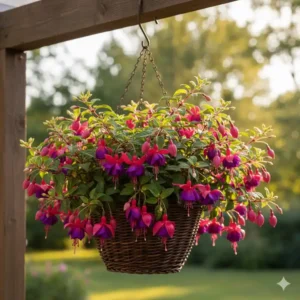
Top 7 Best Perennials for Hanging Baskets: Expert Analysis
I have spent weeks scouring Amazon and reputable nurseries to find the exact varieties that thrive in the unique environment of a suspended container. Here are my top-rated picks.
1. Proven Winners Dolce ‘Berry Marmalade’ Heuchera (Coral Bells)
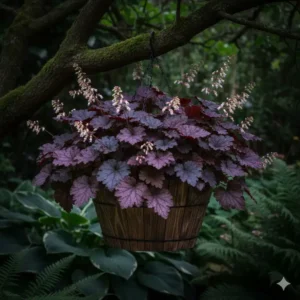
Heuchera is arguably one of the best perennials for hanging baskets because of its incredible color palette. The Proven Winners Dolce ‘Berry Marmalade’ Heuchera offers deep purple-black leaves that look stunning against a white porch or a green garden backdrop. Specifically, this variety is bred for heat and humidity tolerance, making it a “beast” in the southern US.
-
Technical Specifications:
-
Hardiness Zones: 4–9
-
Mature Height: 8–12 inches
-
Spread: 18–24 inches
-
Flower Color: Deep purple foliage with tiny white flowers
-
Brand: Proven Winners
-
-
Customer Review Analysis: Users frequently rave about the “vibrant color” that persists even in the heat. A common piece of feedback is that the plant arrives smaller than expected but “doubles in size within a month.” Some users noted that in deep shade, the purple stays darker, while more sun brings out silver highlights.
-
Professional Applications: Ideal for high-end residential porch displays or “thriller” elements in mixed perennial containers.
-
Pros:
-
✅ Stunning year-round foliage.
-
✅ Extreme cold hardiness.
-
✅ Deer resistant.
-
-
Cons:
-
❌ Can develop crown rot if overwatered.
-
❌ Needs dividing every 3 years.
-
2. Sedum ‘Angelina’ (Stonecrop)
If you have a “brown thumb” or tend to forget about watering, the Sedum ‘Angelina’ is your new best friend. This is one of those best perennial plants for hanging baskets that actually thrives on neglect. Its needle-like foliage is a brilliant chartreuse that turns orange-red in the autumn.
-
Technical Specifications:
-
Hardiness Zones: 5–9
-
Sunlight: Full Sun
-
Water Needs: Low
-
Foliage Type: Succulent
-
-
Customer Review Analysis: Customers love how “impossible to kill” this plant is. One reviewer mentioned it survived a two-week vacation without a drop of water. However, a few buyers noted that it can become “leggy” if it doesn’t get enough direct sunlight.
-
Pros:
-
✅ Very low maintenance.
-
✅ Beautiful color transition in winter.
-
✅ Drought and heat tolerant.
-
-
Cons:
-
❌ Brittle stems can break during shipping.
-
❌ Not suitable for heavy shade.
-
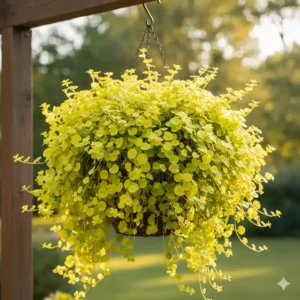
3. Creeping Jenny ‘Aurea’ (Lysimachia nummularia)
For that classic “spiller” look, look no further than Creeping Jenny ‘Aurea’. This plant is a staple in the list of best perennial for hanging baskets because of its aggressive trailing habit and neon-yellow leaves. It creates a literal waterfall of gold.
-
Technical Specifications:
-
Hardiness Zones: 3–9
-
Vining Length: Up to 2 feet in a single season
-
Watering: High (prefers moist soil)
-
Container Size: 4-inch pot to 12-inch baskets
-
-
Customer Review Analysis: The general consensus is that this plant is a “fast grower.” Gardeners in the Pacific Northwest find it performs exceptionally well. Conversely, gardeners in Arizona mention it needs daily water to prevent scorching.
-
Pros:
-
✅ Grows incredibly fast.
-
✅ Brightens up dark corners.
-
✅ Easy to propagate from cuttings.
-
-
Cons:
-
❌ Can be invasive if it escapes the basket into the yard.
-
❌ Will wilt quickly if the soil dries out completely.
-
4. American Plant Exchange Variegated English Ivy ‘Glacier’
For a sophisticated, timeless look, the American Plant Exchange Variegated English Ivy ‘Glacier’ is a top-tier choice. It is one of the best perennials for hanging baskets for indoor/outdoor versatility. The creamy white edges on deep green leaves provide a cool, refreshing aesthetic.
-
Technical Specifications:
-
Variety: Hedera helix ‘Glacier’
-
Hardiness Zones: 4–9
-
Growth Habit: Vining/Climbing
-
Light: Shade to filtered sun
-
-
Customer Review Analysis: Most buyers praise the “high quality and health” of the plants upon arrival. One professional landscaper noted that the English Ivy ‘Glacier’ is more resilient to spider mites than other ivy varieties.
-
Pros:
-
✅ Elegant, classic appearance.
-
✅ Excellent for deep shade.
-
✅ Cleans the air (if kept indoors).
-
-
Cons:
-
❌ Toxic to pets if ingested.
-
❌ Slow to start trailing.
-
5. Vinca Minor ‘Bowles’ Variety’ (Periwinkle)
While often used as a groundcover, Vinca Minor ‘Bowles’ Variety’ makes for a surprising entry in the best perennials for hanging baskets category. Its glossy evergreen leaves and periwinkle-blue flowers in spring create a lush, cottage-garden feel.
-
Technical Specifications:
-
Zones: 4–8
-
Flower Time: Early Spring
-
Size: 4-6 inches high with trailing stems
-
Brand: Various Amazon Nurseries (e.g., Garden Goods Direct)
-
-
Customer Review Analysis: Reviewers highlight the “beautiful blue blooms” and the plant’s ability to stay green through the harshest winters. Some have warned that it can “take over” if not pruned back annually.
-
Pros:
-
✅ Evergreen foliage.
-
✅ Beautiful spring flowers.
-
✅ Extremely hardy.
-
-
Cons:
-
❌ Only blooms once a year.
-
❌ Can look a bit “wild” if not trimmed.
-
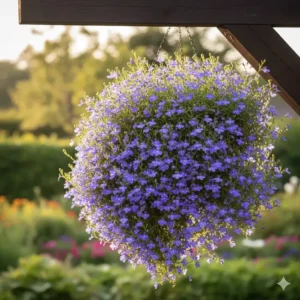
6. Phlox subulata ‘Emerald Blue’ (Creeping Phlox)
Imagine a basket that looks like a giant blueberry muffin—that’s what you get with Phlox subulata ‘Emerald Blue’. It is one of the best perennial plants for hanging baskets for those who want a massive explosion of spring color.
-
Technical Specifications:
-
Zones: 3–9
-
Mature Spread: 12–18 inches
-
Bloom Period: Mid-to-late spring
-
Soil Requirement: Well-drained, sandy
-
-
Customer Review Analysis: People love the “fragrant flowers” and the fact that butterflies are attracted to it. However, some users mention that after the bloom, it just looks like a “green mat.”
-
Pros:
-
✅ Pollinator-friendly.
-
✅ Salt tolerant (great for coastal areas).
-
✅ Cold hardy.
-
-
Cons:
-
❌ Prone to powdery mildew in high humidity.
-
❌ Needs full sun to bloom.
-
7. Polystichum polyblepharum (Tassel Fern)
For those with north-facing porches, the Polystichum polyblepharum or Tassel Fern is a “game changer.” Ferns are technically among the best perennials for hanging baskets because they provide a level of texture that is impossible to replicate with flowering plants.
-
Technical Specifications:
-
Zones: 5–9
-
Foliage: Shiny, dark green fronds
-
Height: 12–24 inches
-
Brand: American Plant Exchange
-
-
Customer Review Analysis: Users appreciate the “uniqueness” of the tassel fern compared to the standard Boston Fern. It is noted for being more drought-tolerant than other ferns once it gets its roots established.
-
Pros:
-
✅ Very sophisticated texture.
-
✅ Evergreen in warmer zones.
-
✅ Handles deep shade perfectly.
-
-
Cons:
-
❌ Not a “trailer”—more of an “archer.”
-
❌ Can be slow-growing.
-
✨ Don’t Miss These Exclusive Deals!
🔍 Take your garden to the next level with these carefully selected products. Click on any highlighted item to check current pricing and availability. These plants will transform your porch into a year-round paradise! 🌿
💬 Just one click – help others make better buying decisions too!😊
Detailed Comparison of Top Recommendations
To help you decide which of these best perennials for hanging baskets fits your lifestyle, let’s break them down by performance metrics.
| Product | Growth Rate | Drought Tolerance | Bloom Appeal | Maintenance |
| Heuchera | Medium | Medium | Low (Foliage focus) | Low |
| Sedum | Fast | High | Medium | Very Low |
| Creeping Jenny | Ultra-Fast | Low | Medium | Medium |
| English Ivy | Medium | Medium | None | Low |
| Vinca Minor | Medium | High | High (Spring) | Low |
| Creeping Phlox | Fast | Medium | Very High | Medium |
| Tassel Fern | Slow | Medium | None | Medium |
Why “Best Perennials for Hanging Baskets” is the Smarter Choice
When we talk about the best perennials for hanging baskets, we are talking about sustainability. Most annuals are grown in greenhouses under perfect conditions, pumped with growth hormones, and then sold to you. Once you get them home, they often go into shock. Perennials, however, are built for the long haul.
The Financial Impact (Cost Comparison)
Let’s look at the math. A high-quality annual hanging basket costs about $35. You buy it in May and toss it in October. Over five years, that’s $175. If you buy a best perennial for hanging basket variety, you might pay $45 for the initial plant and a high-quality pot. Over five years, your cost stays at $45 (plus maybe $10 in fertilizer).
| Item | Perennial Strategy (5 Years) | Annual Strategy (5 Years) |
| Initial Purchase | $45.00 | $35.00 |
| Year 2-5 Replacement | $0.00 | $140.00 |
| Soil/Fertilizer | $15.00 | $25.00 |
| Total Cost | **$60.00** | $200.00 |
| Savings | $140.00 | — |
Environmental Benefits
Furthermore, choosing the best perennials for hanging baskets reduces plastic waste. Every time you buy an annual, you are likely getting a plastic nursery pot that ends up in a landfill. By maintaining the same plants year after year, you’re practicing a more “eco-friendly” form of gardening. According to the Environmental Protection Agency (EPA), reducing waste at the source is the most effective way to protect our environment.
The Science of Growing Best Perennials for Hanging Baskets
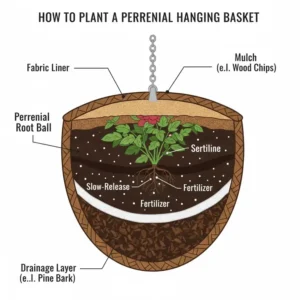
Growing perennials in a suspended environment is slightly different from growing them in the ground. The physics of a basket means the soil dries out faster due to air circulation on all sides. Consequently, you need to understand the relationship between volume, drainage, and root respiration.
1. Drainage and Soil Composition
Don’t just use “dirt” from your backyard. For the best perennials for hanging baskets, you need a soil-less mix that contains perlite or vermiculite. This ensures that the roots have access to oxygen. If the soil becomes compacted, the roots will suffocate, and your perennial will become an “ex-perennial” very quickly.
2. The Role of Pot Materials
The material of your basket matters just as much as the plant.
| Material | Pros | Cons | Best For |
| Plastic | Retains moisture well | Can look “cheap” | Water-hungry plants (Creeping Jenny) |
| Coco Fiber | Excellent drainage/Airflow | Dries out very fast | Succulents (Sedum) |
| Metal/Wire | Very durable | Heavy | Large Perennials (Heuchera) |
| Ceramic | Beautiful/Insulating | Very heavy/Breakable | Indoor/Outdoor Ivy |
3. Understanding Zonal Hardiness in Containers
This is the most important “pro tip” I can give you. When a plant is in the ground, its roots are insulated by the earth. In a hanging basket, those roots are exposed to the ambient air temperature.
“Rule of Thumb: When planting best perennials for hanging baskets, choose plants that are hardy to two zones colder than your actual location.”
For example, if you live in Zone 6, look for plants rated for Zone 4. This gives the roots the extra protection they need to survive a frozen basket during the winter.
Comprehensive Maintenance Guide for Perennial Baskets
To keep your best perennials for hanging baskets looking like they belong on the cover of Better Homes & Gardens, you need a seasonal plan.
Spring: The Awakening
As the temperatures rise, your perennials will start to push out new growth. This is the time to:
-
Remove any dead or tattered leaves from the previous year.
-
Apply a slow-release fertilizer.
-
Check if the plant has become “root-bound.” If the water runs straight through without soaking in, it’s time to repot or divide.
Summer: The Long Haul
In the heat of July, even the best perennials for hanging baskets need help.
-
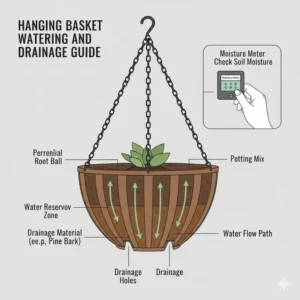
Water deeply until water drips from the bottom.
-
If you’re using Sedum ‘Angelina’, you can be more relaxed.
-
If you’re using Creeping Jenny, you might need to water twice a day.
Autumn: Preparing for Sleep
When the leaves start to change, it’s time to “harden off” your plants.
-
Reduce fertilization.
-
For the best perennials for hanging baskets, consider moving them to a more sheltered spot (like against the side of the house) to protect them from the coming wind.
Winter: The Survival Phase
In very cold climates (Zones 3–5), you might need to bring your baskets into an unheated garage or shed. They don’t need light if they are dormant, but they do need a sip of water about once a month so the roots don’t turn into dust.
Common Myths About Perennials in Baskets
I have heard all the excuses. “Perennials are too heavy!” or “They won’t bloom enough!” Let’s set the record straight.
-
“They are too heavy”: Not true if you use the right soil mix. Modern peat-based mixes are incredibly light.
-
“They don’t bloom”: While some focus on foliage, many best perennials for hanging baskets like Creeping Phlox or Vinca provide spectacular floral displays. Plus, foliage doesn’t “wilt” the way flowers do, so the basket looks “full” longer.
-
“They are too expensive”: We already did the math—they save you a fortune in the long run!
✨ Ready to Grow a Garden That Lasts?
🔍 Don’t settle for “disposable” plants. Grab one of our top-rated best perennials for hanging baskets today and start building a legacy on your balcony. Click the links above to check availability on Amazon! 🛒🌱
Conclusion
Switching to the best perennials for hanging baskets is a total game-changer for the savvy gardener. Whether you choose the fiery colors of the Proven Winners Heuchera or the invincible nature of Sedum ‘Angelina’, you’re choosing a path of less work and more beauty. Gardening shouldn’t be a chore you repeat every May; it should be a relationship you build over years.
I’ve found that my perennial baskets have more “soul” than my old annual ones. They have stories. They’ve survived blizzards and heatwaves, and they come back every year like old friends. So, go ahead—take the plunge. Your porch (and your wallet) will thank you.
FAQs
✅ It depends on your USDA zone. If your plant is hardy to two zones colder than your climate, it may survive. However, in extreme climates, it is safer to move them to an unheated garage or bury the pot in the ground…
✅ Generally, a balanced, slow-release fertilizer (10-10-10) applied in spring is sufficient. Since perennials stay in the same soil for years, replenishing nutrients is more critical than it is for short-lived annuals that die off anyway…
✅ Most perennials will need repotting or dividing every 2–3 years. If you notice the growth slowing down or the roots emerging from the drainage holes, it’s a clear sign that the plant has exhausted its current space…
✅ Absolutely! This is known as a ‘Mixed Perennial Container.’ Just ensure all plants in the basket share similar light and water requirements. For example, pair Heuchera with Tassel Fern for a stunning, shade-loving textural masterpiece… ❓ Can I leave my perennial hanging baskets outside all winter?
❓ Do the best perennials for hanging baskets need special fertilizer?
❓ How often should I repot perennials in hanging baskets?
❓ Which perennial is best for a very sunny, windy balcony?
❓ Can I mix different perennials in one hanging basket?
Recommended for You
- 7 Best Blue Hanging Basket Plants for a Stunning 2026 Garden
- Best Flower Plants for Hanging Baskets: 7 Long-Blooming Favorites Gardeners Love
- Outdoor Wall Basket: 7 Best Durable Picks for 2026 Patio Style
Disclaimer: This article contains affiliate links. If you purchase products through these links, we may earn a small commission at no additional cost to you.
✨ Found this helpful? Share it with your friends! 💬🤗